The intersection of the video game industry and the high-tech collectibles market has reached a new fever pitch. Physical media, long dismissed as mere transitory vessels for software delivery, have evolved into genuine historical artifacts with significant investment value. The recent auction of a factory-sealed copy of Half-Life serves as a landmark event, cementing Valve’s legacy as the definitive cultural cipher of its era. This phenomenon underscores just how deeply nostalgia for early PC gaming has been woven into the contemporary luxury asset market.
The market for rare video games continues its aggressive ascent, and this time, the spotlight has fallen on the cult classic shooter Half-Life. In June 2026, a factory-sealed copy of the game fetched $11,250 at auction, bringing the final tally to $13,725 after commissions. This premium is driven not only by the edition's rarity but also its pristine condition; experts from Video Game Authority assigned it a grade of 85+, which translates to a 9.4 in console grading terms. The NM+ (Near Mint Plus) designation confirms that the specimen has remained virtually untouched—an extraordinary feat for a product nearly three decades old.
The launch of Half-Life in November 1998 signaled a paradigm shift for the FPS genre. Developed by Valve and published by Sierra Studios, the game introduced players to seamless storytelling devoid of traditional cutscenes—a revolutionary approach at the time. The universe later expanded through the Opposing Force, Blue Shift, and Decay expansions, while the 2004 sequel cemented the series as one of the industry's foundational pillars. Even decades later, the franchise's allure persists; the 2020 release of the VR project Half-Life: Alyx reignited a wave of anticipation for the long-awaited third installment.
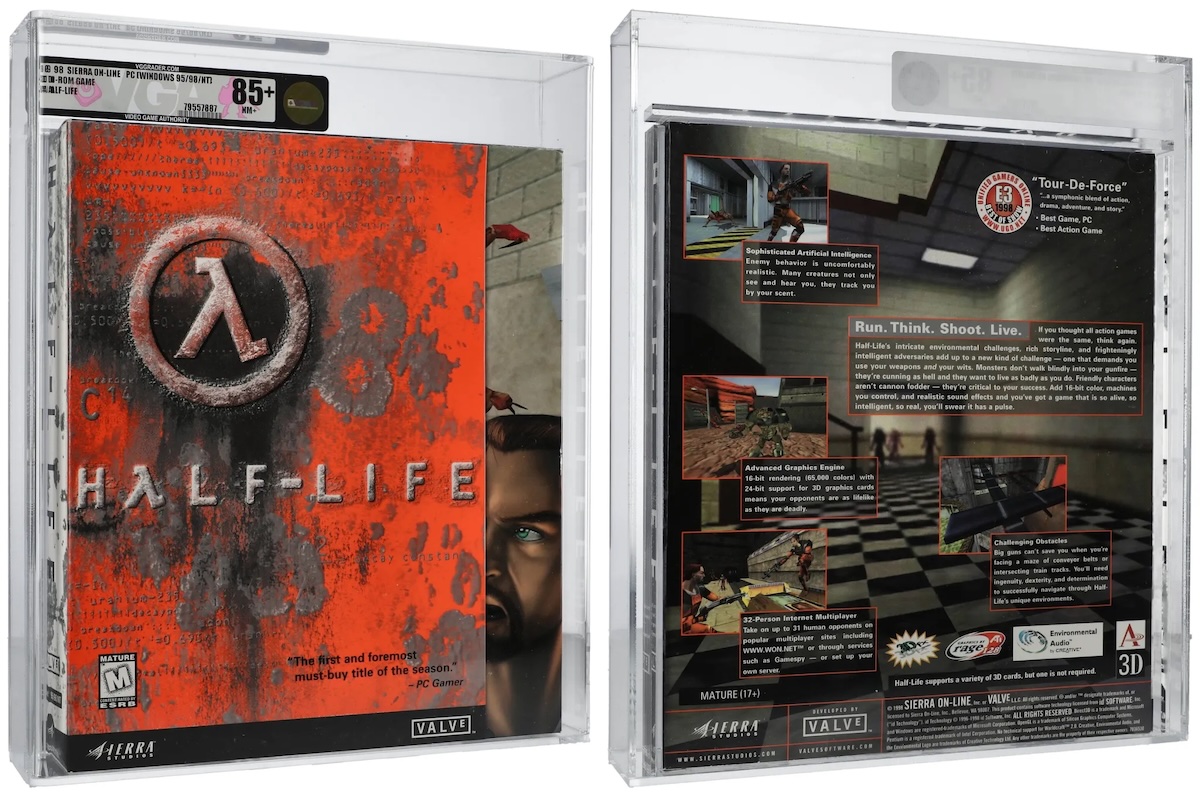
From a material culture standpoint, the late nineties represented a transitional era for software distribution. Massive cardboard "big boxes" were the industry standard, though this period also saw the gradual migration of manuals toward digital PDF formats. Before the mass adoption of DVDs, these big boxes remained the primary packaging method and are now highly coveted by collectors. While weathered copies of Half-Life occasionally surface on secondary markets like eBay, factory-sealed specimens have become true rarities.
To put this record into perspective, one must look at previous landmark transactions in the PC segment. For instance, id Anthology collections—featuring id Software classics like Doom, Wolfenstein 3D, and the Commander Keen series—typically topped out around $3,000. A more significant precedent was the sale of Akalabeth: World of Doom for the Apple II in January 2022 for $11,211. Released back in 1979 as the progenitor of the Ultima series, it held the title of the most expensive computer game for some time.
Parallel to the appreciation of physical relics is the evolution of digital legacy. In 2020, Crowbar Collective released Black Mesa, a fan-made reimagining of the original Half-Life that effectively translated the classic into the language of modern technology. With overhauled graphics, updated sound design, and support for contemporary displays, the game found a second life while meticulously preserving the spirit of the original.
Yet, even the record-breaking sale of Half-Life pales in comparison to the broader auction market. In that same June 2026, Heritage Auctions recorded a phenomenal transaction: a sealed copy of Super Mario Bros. for the NES sold for $3 million. This highlights the colossal valuation gap between console and computer antiquities, where Nintendo's standardized packaging creates a more rigid and lucrative collectors' market compared to the fragmented landscape of PC gaming.
 The Environmental Cost of Google’s Neural Networks